
Global high-mix volume high-speed PCBA manufacturer
9:00 -18:00, Mon. - Fri. (GMT+8)
9:00 -12:00, Sat. (GMT+8)
(Except Chinese public holidays)





HomePage > Blog > Knowledge Base > Exploring the PCBA Manufacturing Workflow: From SMT to Final Testing
Table of Contents
1. What Must Be Settled Before the First Board Is Loaded?
2. How Do the Right Components Reach the Line?
3. What Decides Solder Quality Before Reflow Starts?
4. Why Does the Line Stop for the First Article?
5. Which Solder Defects Can Inspection Actually Catch?
6. How Do Through-Hole Parts Join a Board That Is Mostly Surface-Mount?
7. What Does Final Testing Prove That Inspection Cannot?
8. What Leaves the Factory with the Boards?
A repeat build can use an approved design and still contain the wrong part. The BOM revision, feeder loading, and placement program all have to agree. If engineering approves a substitute, its package, pin assignment, and temperature rating may alter the assembly instructions. The PCBA manufacturing process needs defined approvals before material loading, after the first article, and after rework.
SMT starts with solder paste printing, followed by placement and reflow. IQC and material preparation precede this sequence. Joint inspection, through-hole assembly, and testing follow the route chosen for the board. Double-sided SMT typically repeats solder paste printing, component placement, and reflow for the second side; firmware loading and test fixtures depend on the product. Use the manufacturing plan to identify that route before accepting a quotation.
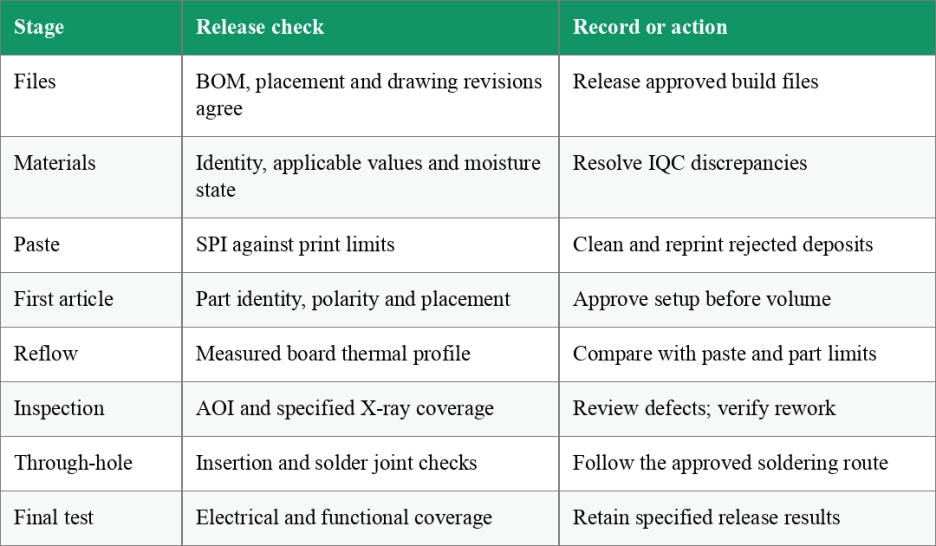
Release the Gerber data, BOM, placement coordinates, and assembly drawing under a consistent revision. The BOM identifies the approved part; placement data gives its position and rotation; the drawing resolves polarity and assembly notes. Our BOM error-checking and SMT automatic programming systems support this preparation. A package mismatch needs engineering review before loading. Record approved substitutions and do-not-populate positions as well, so a repeat order follows the same instructions. The table summarizes the release checks through the build.
Specify firmware, programming access, and acceptance limits while the order is being quoted. Include the supply conditions, interfaces, expected responses, and any loads needed for functional testing. Fixture design depends on this information and on access to connectors or test points. If the design changes, check whether the fixture and test program still match the revised design. A firmware revision should identify the programming file and the version the test must verify.
Material approval begins before goods receipt: we buy from original manufacturers and authorized distributors, with supplier qualification and annual audits in the purchasing system. At IQC, LCR measurement addresses component values where applicable; X-ray counters establish reel quantities. A matching label alone does not verify component values or reel quantities. During storage, we use ESD-safe containers for material receiving and issuing, and the warehouse uses ESD grounding wires. High-value stock is managed separately. FIFO issue, periodic inventory checks, and quality inspections continue while stock is held. Moisture-sensitive components are stored in controlled low-humidity cabinets as required. Materials with temperature-specific storage requirements are stored according to the manufacturer's instructions. For any required bake, review the component instructions and recorded exposure first. Carrier temperature limits also matter; a reel suitable for storage may need replacement with a baking-rated carrier.
PCBasic's smart material system assigns QR codes to materials and checks scanned loading information against the assembly program. A mismatch produces an error. This check matters when reels contain parts with the same package and different values: appearance alone may be insufficient to distinguish them. Keep the BOM, material identification, and placement program synchronized whenever a substitute is approved. A correct scan against an obsolete program would still use the wrong build definition.
The printer deposits solder paste according to the approved stencil design and print specifications. A stencil aperture or alignment problem is still accessible at this point. Our ASE printers work with BPC-707KD solder paste inspection equipment, and we make stencils using in-house laser cutting. 3D SPI measures solder paste volume, height, area, and positional offset against defined acceptance limits. A rejected print can be cleaned and reprinted under the approved process. Repeated rejects call for a check of the stencil and printing conditions.
Package outline is a poor guide to whether the correct component has been placed. Compare the fitted value, orientation, and polarity with the released data, particularly for similar-looking parts and fine-pitch packages. Our Fuji NXT and Juki machines use the approved placement program. For SMT assembly services, send the first-article requirements with that data. Pre-reflow inspection comes next in our SMT route; after reflow, AOI and visual inspection identify boards for rework before SMT-stage QA. Correcting placement in wet paste and reworking a soldered component are separate operations with different controls.
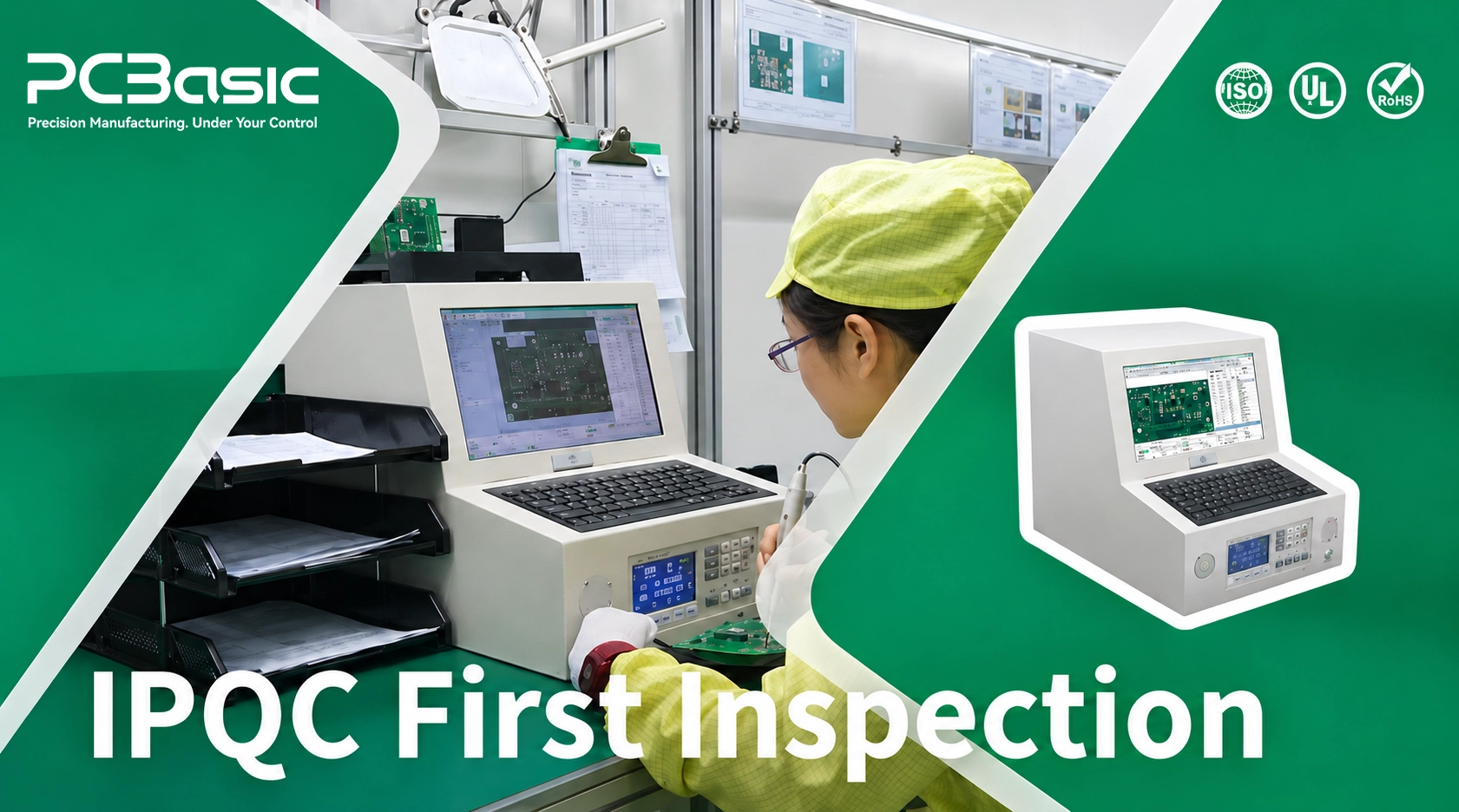
A reversed diode on the first board is a reason to stop and correct the setup. Continuing would repeat that orientation on subsequent boards. Our self-developed first article inspection system supports this check together with BOM checking and inspection of the assembly. Part identity, value, polarity, and placement need verification using methods suited to the component. Approval releases the setup for volume production. It records the starting condition; inspection during the run is still needed because material loading and process conditions can change after the first board.
The oven recipe gives zone settings. A thermal profile shows what the assembly actually experiences as it travels through those zones. With our JTE1000 reflow ovens and KIC profiler, thermocouple readings can be compared with the chosen paste's process window and the component limits. Copper distribution and larger packages affect heating, so the temperature at one location may differ from another. Keep the approved measured curve with the build information. A later material or layout change may require a fresh measurement before that recipe is used again.
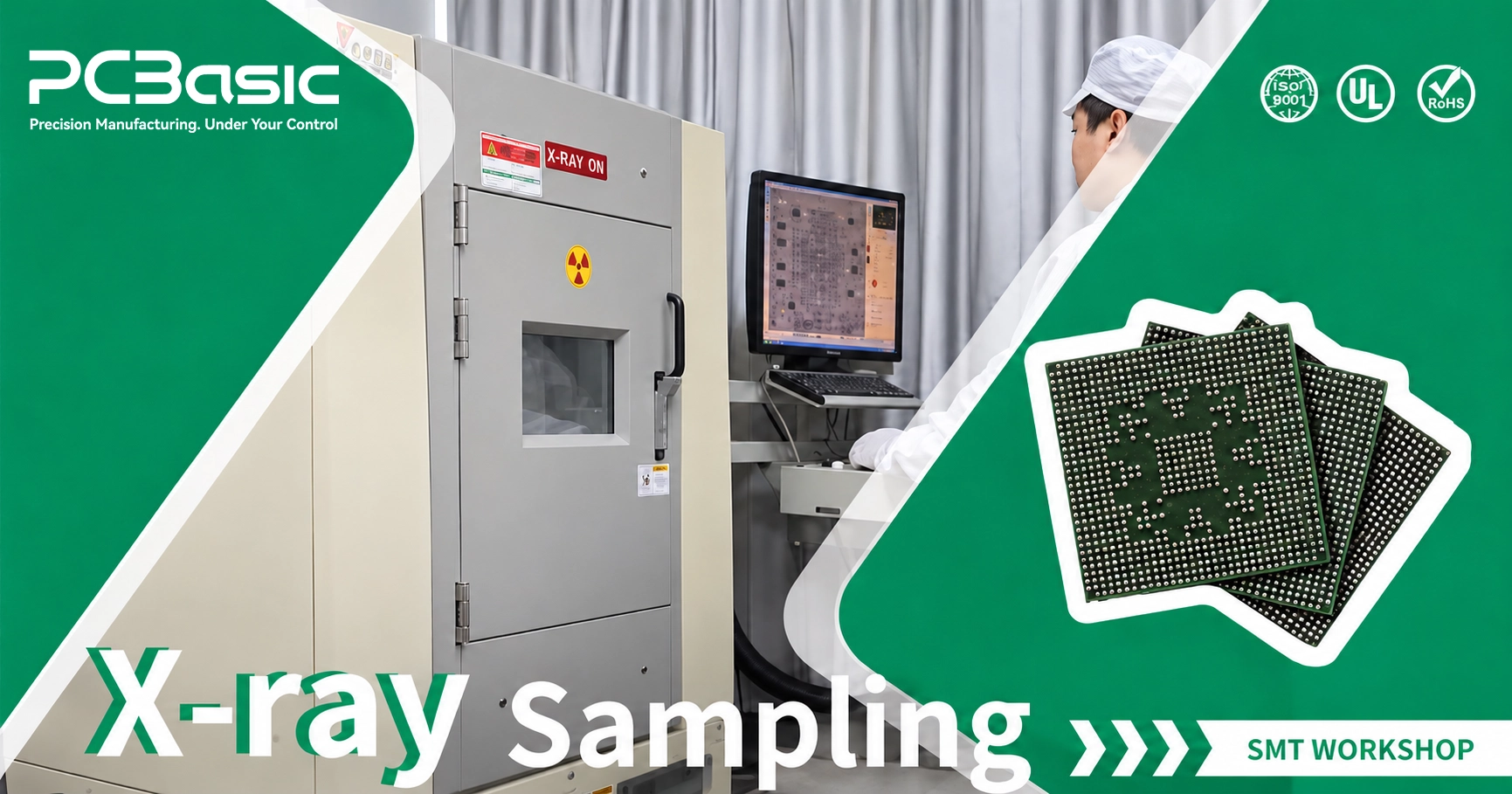
An optical view can show an accessible joint and the position of a component. It cannot show the connections covered by a BGA body. Our VCTA-A480 AOI and XSCAN-7130 X-ray equipment provide these different views after reflow. X-ray examination can reveal hidden bridging, missing solder, and voids, with the inspection scope set for the assembly. The photograph below shows sampling. The order therefore needs to identify which packages are examined, how coverage is selected, and which acceptance criteria apply. Neither type of image provides a complete electrical or functional test result.
Start a defect investigation with the affected joint and the preceding process records. Bridging may involve too much paste, poor alignment, or the soldering conditions. For solder balls, compare paste handling, printed deposits, and the measured thermal profile before choosing a correction. With tombstoning, the two terminations have wetted unevenly, so compare pad geometry, paste deposits, placement, and heating. Poor wetting and open joints need examination of the surfaces, flux activity, and temperature. The observed symptom narrows the investigation. Changing an oven setting or baking parts before checking those details can leave the cause unresolved. Electrical testing adds evidence where the connection is accessible to the chosen test.
A mixed assembly needs a soldering route for its through-hole connectors as well as its surface-mount parts. The common SMT-then-wave route must suit the connector's temperature rating and the underside layout. PCBasic's through-hole assembly operations include component insertion, NSI350 wave soldering, and manual touch-up where required. A reflow-rated connector may be suitable for pin-in-paste assembly if the PCB layout, hole-to-pin geometry, stencil design, and available solder volume support the required hole fill and joint formation. Record the selected option in the released PCBA assembly process, including the heat exposures involved.
Our DIP flow places inspection ahead of the wave and again after soldering. Before a populated board reaches the wave, check connector polarity, position, and seating. A wave soldering fixture must protect the intended areas without obstructing the joints that need solder. We make these fixtures from materials such as glass-fiber-reinforced composites. After the wave, inspect the joints to the order's acceptance criteria and verify any manual touch-up. Approval of the initial insertion does not establish the quality of a later repair.
The test requirement starts with the fault being sought. An open net calls for electrical access to that connection. A startup failure may require power, firmware, and a functional sequence to reproduce it. Flying-probe testing uses programmed probe positions at accessible circuit points, avoiding a dedicated bed-of-nails fixture. Depending on circuit access and tester capabilities, it can detect opens and shorts, measure selected component values, and verify the polarity of certain components. Through our PCBA testing services, functional testing exercises the supply conditions, interfaces, and responses agreed for the board. Specify the required coverage for the PCBA process; a test record describes the conditions and functions actually exercised.

The firmware image needs a revision identifier just as the BOM does. For programming, provide the approved firmware image or configuration file for the target MCU, FPGA, or memory device. We support multi-channel programming and make custom functional fixtures through an independent fixture manufacturing center. A board revision can affect the fixture contacts or the test program, so these items belong in the change review. Specify burn-in or environmental tests by stress, duration, and sample coverage. A temperature cycle, humidity exposure, vibration run, and drop test address different failure mechanisms; each needs its own limits and acceptance criteria.
Before shipment, settle the sequence for cleaning, drying, coating and depaneling. Probe contact and areas requiring coating masks can constrain when testing is carried out. PCBasic has automatic cleaning equipment; conformal coating and depaneling appear in our production route where required by the order. Keep depaneling forces away from vulnerable areas, including ceramic components near board edges. Our release controls extend through finished-stock inspection, pre-shipment inspection, and packaging monitoring. Check the finishing requirements at final QA and use the specified anti-static packaging.
Use the shipped board or lot identifier to retrieve its manufacturing record. Retain the assembly revision, approved substitutions, and specified test results against that identifier. Our self-developed MES supports production monitoring and traceability, alongside IQC and first article inspection systems. The live production views cover the warehouse, stencil department, quality, and packaging. Production tracking is also available through our digital platform. At PCBasic, we agree which records the order requires, how they are linked to the shipment, and what the customer receives. Confirm the agreed report fields when the order is reviewed.
Production release depends on agreement between the build files, the assembly route and the evidence required at shipment. An unapproved substitute needs a BOM decision; a rejected paste print needs correction before placement; a repaired joint needs verification. For a manufacturing review, send the Gerber data, BOM, placement file, quantity and firmware requirements, plus the required test limits and delivery records. These inputs allow the route and acceptance requirements to be reviewed with the project team before the build is released.
Q1: Does changing a component on a repeat order require another review?
A1: A substitute needs a check of package, pin assignment, polarity, temperature limits, and its electrical role. The approval may also change placement data, the thermal profile, or a test limit. Update the released BOM and the affected production instructions together.
Q2: Does every through-hole connector require wave soldering?
A2: Check the connector's permitted soldering method and the board layout first. Many mixed assemblies use wave soldering after SMT. Reflow-rated parts can be assessed for pin-in-paste, subject to a suitable footprint and qualified process. Approve that choice, its heat exposures, and the inspection method in the PCBA assembly process.
Q3: Can a passed functional test replace inspection and traceability?
A3: A functional pass describes the behavior tested under the specified conditions. It does not record the board's component history or examine every assembly characteristic. Retain inspection findings and material history alongside the functional result in the PCBA quality control record. At quotation, define the PCBA testing reports and traceability information required for acceptance.

Assembly Enquiry
Instant Quote





Phone contact

+86-755-27218592
In addition, we've prepared a Help Center. We recommend checking it before reaching out, as your question and its answer may already be clearly explained there.
Wechat Support

In addition, we've prepared a Help Center. We recommend checking it before reaching out, as your question and its answer may already be clearly explained there.
WhatsApp Support

In addition, we've prepared a Help Center. We recommend checking it before reaching out, as your question and its answer may already be clearly explained there.
