
Global high-mix volume high-speed PCBA manufacturer
9:00 -18:00, Mon. - Fri. (GMT+8)
9:00 -12:00, Sat. (GMT+8)
(Except Chinese public holidays)





HomePage > Blog > Knowledge Base > Automotive PCBA Supplier: AEC-Q, IATF 16949, and Reliability Evidence
Table of Contents
1. Why Does an Automotive PCBA Supplier Need More Than a Clean Solder Joint?
2. Which AEC-Q Component Grades Does Your Board Actually Require?
3. What Does an IATF 16949 Quality System Add to PCBA Sourcing?
4. How Should the PCBA Supplier Prove Component and Batch Traceability?
5. Which Inspection and Reliability Tests Close the Evidence Chain?
Bench tests pass. Volume starts. Now the same automotive ECU misbehaves — a fresh component lot, a hotter cabin, a connector pulling more current than the prototype ever did. Reflow is only one possible cause. The investigation becomes harder when nobody can say which component qualification and temperature rating applied to each critical part, who supplied it, or what was checked. Automotive programs live and die on that paperwork — grades, channels, checks, records. Line utilization and unit price can wait. Get the documents in front of you before a quote hardens into a delivery date.
Ask four questions of that chain. What AEC-Q grade sits on the critical parts? What IATF 16949 system governed the build? Which batch record ties material to process and test? Do the inspection and functional test results actually close the loop? Different evidence sits behind each answer. One weak link and a field fault stay unexplained.
A visually acceptable solder joint provides evidence of visible workmanship. It does not, by itself, prove correct component selection or long-term reliability. Not that it carries the grade your application zone demands. Not that the lot came through an authorized channel. Not that batch ten will behave like batch one. Tidy joints are the entry ticket. Treat them as the whole of quality, and a board that behaved in the pilot run quietly drifts at volume. A PCBA supplier who offers only a populated board and a pass/fail stamp hands the risk back to your product team.
Failure risk hides on both sides of the reflow oven. Upstream, it is component selection: drop in a part with a different grade, package, or thermal class, and the board still powers up on the bench, then dies months later under heat or vibration. Downstream, it is paperwork. A field fault is easier to investigate when someone can identify the lot, the date code, and the sourcing channel. Solder joints are just one important part of this. PCBA reliability is decided in the component file, the quality system, and the trail from a batch back to its materials and its test results.
A pass/fail label answers today’s question: does this board work? The evidence chain answers tomorrow’s: can you reproduce that result, and can you investigate the next board that fails. One supplier hands you something to audit. The other asks you to trust. PCBasic runs an IATF 16949 quality control system that documents exactly these records — check it early, well before an automotive PCBA conversation slides toward price.
AEC-Q qualification applies to components, not to the PCBA supplier or the assembled board. For ICs, AEC-Q100 defines operating-temperature grades. For other component classes, verify the applicable AEC-Q standard and the manufacturer’s specified operating-temperature range. An infotainment module behind the dash sees a gentler envelope than a powertrain controller or a battery interface bolted under the hood. So, work backwards from the zone. That is where an automotive PCBA AEC-Q requirement really starts: The installation zone helps define the thermal requirements, while actual operating conditions, self-heating, and customer specifications determine which devices are suitable.
Qualification follows the component class, not the board. AEC-Q100 takes integrated circuits. AEC-Q101 covers discrete semiconductors — diodes, transistors. AEC-Q200 takes passives: resistors, capacitors, inductors. For each critical device, a PCBA supplier should pin the part number to its AEC-Q grade and rated temperature class, then file the datasheet next to any approved alternates. Settle that automotive PCBA AEC-Q mapping before the quote. Afterwards, a wrong grade costs a rework. Beforehand, it costs a conversation.
A mapping is worth nothing until real material shows up at the dock. The control point is the incoming material inspection record, which should link the received part number and manufacturer to the approved BOM, lot/date code, sourcing documentation, inspection result, and any approved substitution. Read it like an investigator — part number, manufacturer, and result against the BOM, with every alternate approved up front. Fill those fields for the real lot, and an automotive PCBA AEC-Q claim stops being a promise on paper. These records support verification that the received material matches the approved part, while the manufacturer’s qualification documentation supports the AEC-Q claim.
Start with what the standard adds. IATF 16949 builds on ISO 9001 requirements and adds automotive-specific quality-management requirements, and the extra layer is the part that counts: control plans, process FMEA, design FMEA where the supplier is responsible for product design, measurement-system analysis, and defined processes for nonconforming material and corrective action. A certificate on the wall proves very little. What matters is whether the system reaches your board, and whether its records can answer a question nobody thought to ask until the field asked it.
A quality system proves itself the first time something breaks, and somebody has to find out why. The record that carries weight logs one nonconformance: what went wrong, when it was raised, what fix was applied, who signed it off. Offer only a pass/fail outcome, and you have nothing to investigate with. Investigation and corrective action are important parts of the standard’s broader focus on defect prevention and continual improvement.
Auditing an IATF 16949 PCBA supplier? Ask for that record from a real lot. Then ask whether the control plan names the special process and the record that follows it. A rejected lot, a rework, a supplier change — each should leave a dated entry with an owner’s name. Those entries provide evidence of implementation; root-cause analysis and effectiveness checks show whether the corrective actions worked. See nothing but passes, and the system is describing a result it cannot explain.
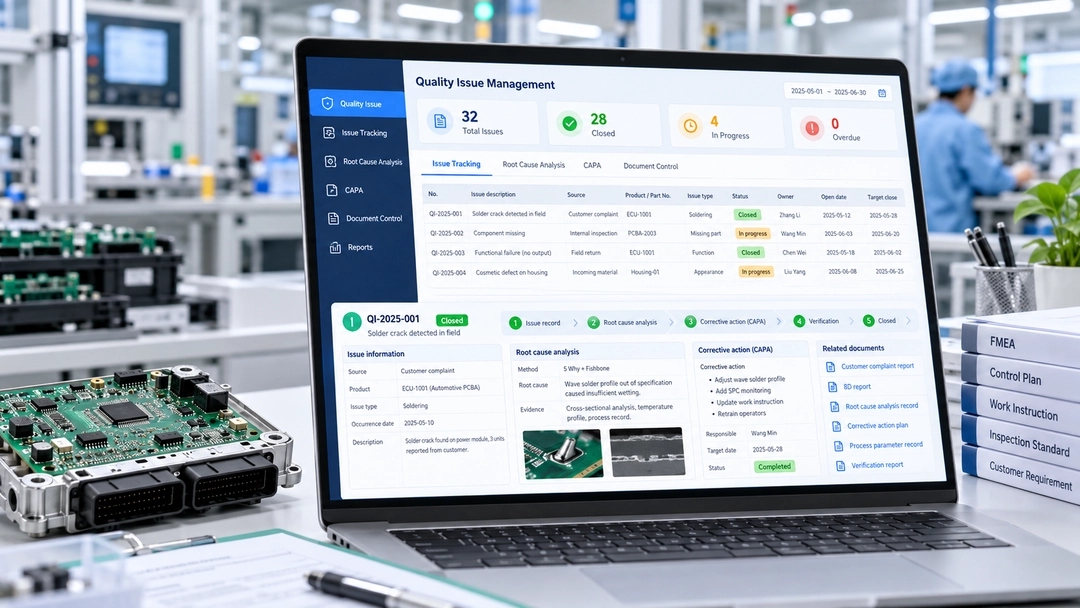
Traceability ties evidence to one batch instead of a drawer of paper, and it starts before a single part is placed. Supply-chain quality problems can begin before material reaches the assembly line: a fault surfaces months later, and nobody can name the lot, the date code, or the channel it came through. The controls include approved-source purchasing, review of sourcing documentation, and risk-based incoming inspection, with receipt photos and inspection results linked to the order.
PCBasic’s central warehouse runs on original-manufacturer and authorized-distributor channels, and IQC stands at the door on incoming material. That is what makes the first control something you can inspect rather than something you are told. Arrival photos are the item buyers ask for most. They document the material received; production records are needed to confirm what was actually used and whether any substitution was approved.
Once material is inside, a batch identifier pulls material, process, and test onto one thread. The fields worth having: BOM revision, batch number, process route, and the quality-control entries that name what was checked at each step, from first-article result to functional-test outcome, written into a self-developed MES. Supply chain PCBA quality holds only as long as the weakest link. The linked records should be retrievable for a named batch and consistent across the systems involved.
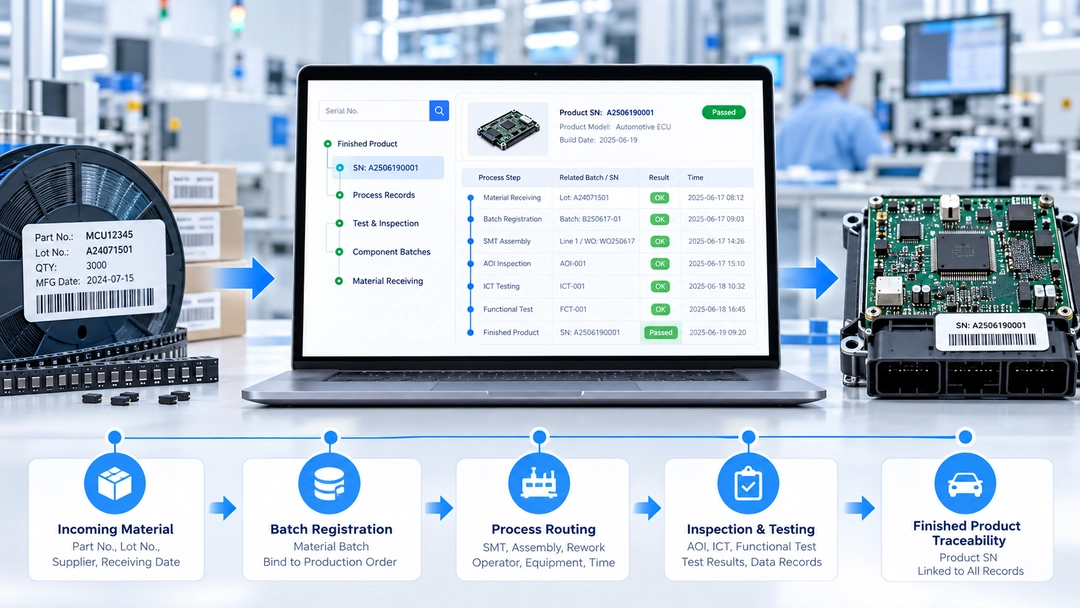
Keep the test small. Ask for one sample batch record. Then check whether it names the lot, the date code, the inspection result, and the functional outcome, and whether somebody can actually retrieve it while you wait. If it does, the traceability claim is real, and you can pair that review with PCB assembly services that show the same fields for every batch rather than the pilot run alone. One request, before volume, tells you more than any capability presentation.
Testing closes the chain when each method is aimed at something it can genuinely verify. SPI reads printed paste before reflow. AOI checks component placement, visible polarity markings, and visible solder-joint conditions. X-ray reaches joints no camera can see — BGA, QFN, the whole bottom-terminated family. Functional testing exercises defined behaviour under the specified supply, load, and interface conditions.
Each method covers its own ground. None of them replaces the vehicle-level validation your product team still owns. Every one is a PCBA reliability control, so tie it to the risk it actually covers and keep the inspection record, or the result cannot be reproduced. Ask for the X-ray record by lot. X-ray can reveal certain hidden-joint defects that AOI cannot assess, but detection depends on the inspection method and defect type. Retain the inspection results and document the disposition of any detected defects.
Routine inspection and functional testing do not, by themselves, establish long-term reliability. Where required by the agreed validation plan, board- or module-level testing may include temperature cycling, vibration and humidity exposure, with defined conditions and acceptance criteria.
The decision table below gives every evidence link a single job: the risk it closes, the question to put to the PCBA supplier, and how you verify the answer. One job per row keeps a review usable. A wall of claims cannot be checked. A row that answers one question can always be matched against a document.
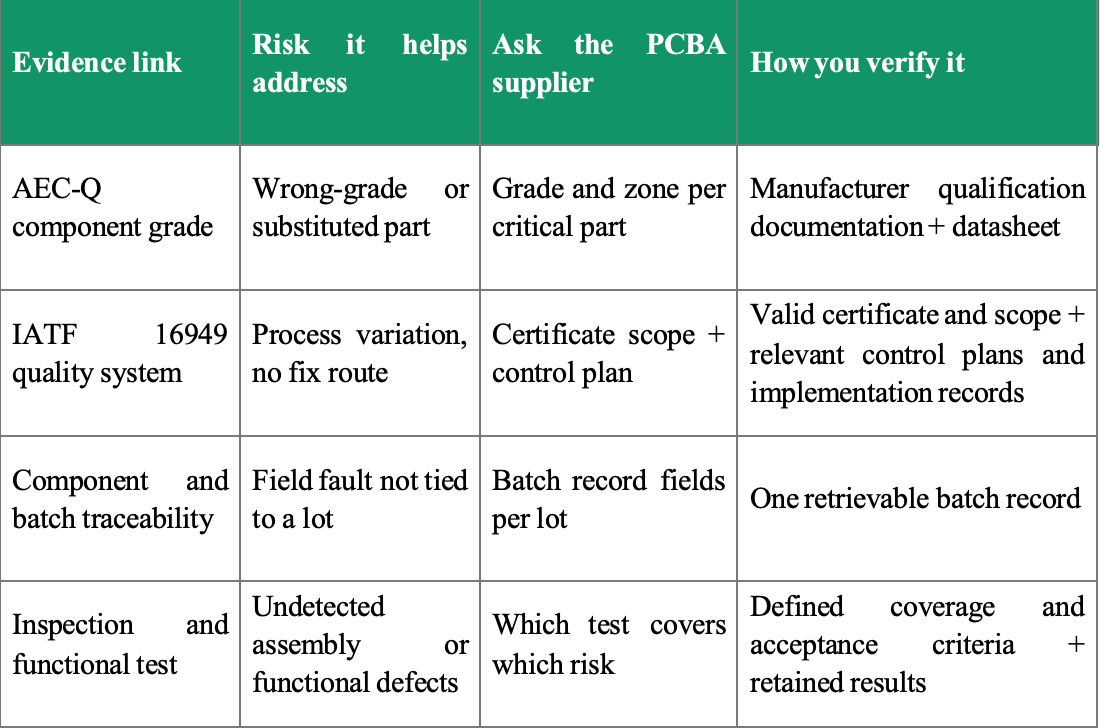
A manufacturing record makes the board-level build comparable, investigable, and repeatable. It says nothing about whether the finished vehicle system complies or stays fault-free. That acceptance belongs to your product team, and asking an assembly house to carry it muddies who owns what. Once board files are ready, the assembly route gets evaluated against the actual combination of SMT and through-hole assembly, hidden solder joints and test-access requirements, including PCBA functional testing, rather than a generic equipment list. Hold that boundary and the evidence chain stays honest. The supplier provides evidence of manufacturing conformity and agreed verification activities. Vehicle-level integration and validation remain with the responsible OEM or system integrator, with supplier support as agreed.
Judge an automotive PCBA build the only way that matters: can the evidence chain be checked. Impressive line counts and sharp pricing say nothing about it. The chain has four links, and they fail one at a time. Critical parts carry AEC-Q grades matched to their zone. An IATF 16949 quality system reaches your board and keeps the records. One retrievable batch record ties material, process, and test together. The right inspection and functional checks close the loop.
PCBasic’s IATF 16949 system, its IQC and MES-based traceability, and a documented inspection and functional-test route give a buyer real things to check against a real board. Set the BOM, the AEC-Q grades, and the test conditions, then ask for a manufacturing review. That is where these controls become visible, before a quote narrows to price and lead time.
Q1: Is AEC-Q100 a certification the PCBA supplier holds?
A1: No. AEC-Q100 applies to IC qualification, not supplier or board certification. The device manufacturer performs and documents the qualification; the PCBA supplier verifies that the approved parts are used.
Q2: Does IATF 16949 certification guarantee an automotive PCBA will pass?
A2: No. Certification documents a quality-management system. The approved files and materials, the inspection scope, the test conditions, the traceability fields, and the acceptance criteria for your board should be agreed upon by your team and the supplier.
Q3: What is the minimum evidence to request before placing an automotive PCBA order?
A3: A released BOM and board revision carrying the AEC-Q grades, the approved alternates, the supplier’s IATF 16949 scope, an IQC and traceability record for a sample batch, and the inspection and functional-test plan with its acceptance criteria.

Assembly Enquiry
Instant Quote


Phone contact

+86-755-27218592
In addition, we've prepared a Help Center. We recommend checking it before reaching out, as your question and its answer may already be clearly explained there.
Wechat Support

In addition, we've prepared a Help Center. We recommend checking it before reaching out, as your question and its answer may already be clearly explained there.
WhatsApp Support

In addition, we've prepared a Help Center. We recommend checking it before reaching out, as your question and its answer may already be clearly explained there.
