Table of Contents
1. What Makes a Smart Agriculture PCBA Different from
General-Purpose Electronics
2. From Sensor Reading to Field Action:
The Electronics Chain in Smart Farming
3. Four Design Decisions That Shape
Smart Agriculture PCBA Reliability
4. Turning the Design into a Field-Ready
Smart Agriculture PCB Assembly
5. How to Validate A Smart Agriculture PCBA Before
Field Deployment
6. Conclusion
7. FAQs
The farm is becoming increasingly connected,
with electronics operating across the field. The soil probe, weather station,
drone fleet, and self-steering tractor. All of these technologies depend on one
tiny but crucial part: the printed circuit board assembly (PCBA) running inside
each one. It's the smart agriculture PCBA that makes a sealed plastic housing
in a muddy field into something that measures the soil moisture, opens a valve,
or controls a sprayer with centimeter precision.
The global smart agriculture market is expanding
rapidly, and there are industry estimations that forecast that the whole sector
will expand from its current volume that's estimated to be around the
mid-twenties in billions of dollars to more than seventy billion dollars in the
coming decade, from $28.29 billion in 2026 to $72.22 billion by 2034.
Each one of these billions ends up in the hands
of the circuit board assembly that should withstand dust storms, freezing
morning temperatures, and a tractor driving on top of a buried cable.
In this article, you will understand what
differentiates smart agriculture PCB assembly from a normal one, how
information flows from an electronic signal to an actual field action in the
farm, the factors that determine reliability and how the manufacturing process
transforms a schematic to a field-ready product.
What Makes a Smart Agriculture PCBA Different
from General-Purpose Electronics
However, even in this era, customers tend to
keep these gadgets indoors, plugged into a power outlet on the wall, and
replace them after a few years. On the other hand, farmers can place the smart
agriculture PCBA within a plastic housing in the arm of the irrigation
center-pivot, in the root zone underground, and leave it there for an entire
growing season. Thus, all the engineering assumptions must be revised.
The Farm Environment Changes the Reliability Target
Depending on the location and season, field
electronics encounter temperatures ranging from sub-zero in the morning to much
above 40°C in the afternoon. Factor in dust, fertilizer build-up, insect
infiltration, and the odd deluge, and field electronics experience a stress
pattern more akin to automotive or marine electronics rather than standard
office electronics. Agricultural electronics that are not designed for their
expected environment may therefore fail prematurely.
Consider a soil sensor mounted at root depth.
The sensor will have to endure the freeze-thaw cycle of the seasons, exposure
to chemicals from fertilizer runoff, and the stress of insertion in compacted
soil. These field stresses can go beyond the conditions assumed for many
consumer-electronics applications, and they can influence the design of a smart
agriculture PCBA from the beginning.
Reliability Depends on the Whole Electronic System
The strength of a board can only be as good as
its weakest point, which may be a connection, a battery, or a solder joint.
Proper agriculture printed circuit board assembly involves taking into
consideration not only the board but also its enclosure, cable connections, and
even the power supply as a single unit. This process often gets overlooked,
leading to field units getting sent back under warranty repairs after a year or
so.
When a farmer encounters an issue with their
equipment, there is no time for troubleshooting in the middle of the growing
season. This is exactly why agricultural electronics products require more
stringent reliability engineering measures than other commercial products.
From Sensor Reading to Field
Action: The Electronics Chain in Smart Farming
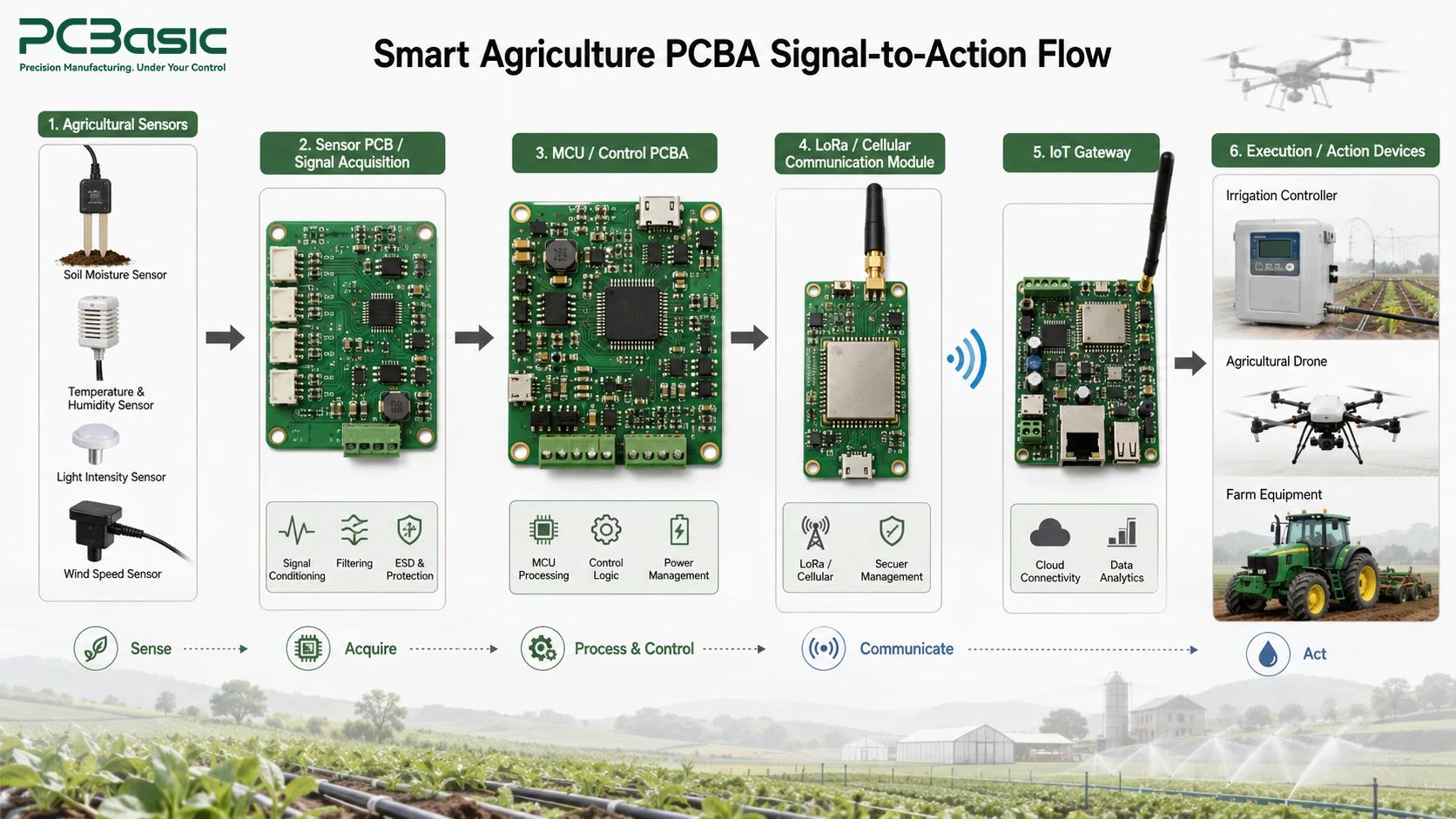
Each automated irrigation valve or flight path
of a drone is based on a series of electronic decision-making. The knowledge of
such a series of decision-making is critical in explaining the requirement of
agricultural IoT sensors.
Agricultural Sensors and Field Data Acquisition
Soil moisture sensors, leaf wetness sensors, and
weather stations serve as the first link in the chain. These environmental
sensors and soil sensors may generate low-level analog signals or digital data,
and the circuit board must condition and process the signals before electrical
noise or drift degrades measurement accuracy. Proper signal conditioning can
help agricultural sensors maintain stable and repeatable measurements.
Agriculture IoT Devices and Communication Gateways
After collecting data through sensors, it has to
be transmitted to the dashboard or control panel. Agriculture IoT gateways
collect data from numerous nodes and transmit it through cellular, LoRaWAN, or
satellite connections, usually from places where there is no electricity grid
nearby. Many IoT devices agriculture PCB assembly projects require RF modules
which work effectively on batteries.
Controllers,
Actuators, Drones and Farm Machinery
The last connection translates data into action.
An irrigation controller PCB can control valves or pumps in smart irrigation
systems to regulate water delivery. The agricultural drone PCB controls the
stability of its flight and activates the spray nozzle at the mapped
coordinate. Agricultural drones likewise combine navigation, sensing,
communication, and actuator-control functions.
The farm equipment PCB in the planter or sprayer
unit synchronizes the GPS navigation with mechanical drives. Reliability is
especially important in agricultural equipment PCB assembly because a
controller failure can interrupt planting, spraying, or other field operations
and may not be easy to service on site.
The GPS-guided steering must be highlighted
among all. RTK GNSS-based precision steering can provide centimeter-level
positioning under suitable conditions, helping agricultural machinery follow
consistent guidance lines and reduce unnecessary overlap. Such systems require
receiver electronics that can maintain signal integrity and provide accurate
positioning data with sufficiently low latency for the control system.

Four Design Decisions That Shape
Smart Agriculture PCBA Reliability
By the time the parts get to the pick-and-place
machine, several design decisions will already have a major influence on field
reliability. The following four areas are particularly important for smart
agriculture PCBA design.
Protect Sensor Accuracy from Electrical Noise
Long cables in close proximity to motors or
frequency drives will likely pick up interference. Appropriate grounding, cable
shielding, and analog filtering can help reduce interference and preserve
measurement accuracy. Without adequate noise control, electrical interference
may distort sensor readings and affect the performance of the smart agriculture
PCB assembly.
Design Power Around the Real Load Profile
Many remote field devices are battery- or
solar-powered and spend much of their time in low-power modes, waking
periodically to collect or transmit data. If the power design assumes that the
devices are continuously communicating, then the system will consume energy at
a rate that is much higher than anticipated during cloudy days. The load
profile therefore has a major influence on battery life and system
availability.
Treat Wireless Connectivity as Part of PCB Design
Modern agricultural electronics use cellular
modules, LoRa radios, or satellite radios more frequently, and antenna
placement is not something that is just added later. Ground plane cutout
dimensions, RF trace impedance, and enclosure material affect the performance
of radio, and wireless range therefore needs to be considered during PCB design
and validated through testing.
Design for Moisture, Vibration and Physical Interfaces
Boards intended for outdoor use may require conformal coating or other environmental protection depending on the enclosure, moisture
exposure, contamination risk, and service conditions. Also, the component
placement must account for vibration in tractors, pumps, or drone motors, as a
component may survive shaking on a laboratory workbench but not months later in
a vibrating machine.
Livestock monitoring tags and greenhouse control
systems present even more challenges. A livestock-monitoring tag may need to
withstand mechanical shock and significant water exposure, while a greenhouse
controller may operate in a warm and humid environment for long periods. Thus,
both these applications of agricultural sensors and controllers lead to the
same result – moisture and mechanical protection are not luxuries but basic
necessities.
Turning the Design into a
Field-Ready Smart Agriculture PCB Assembly
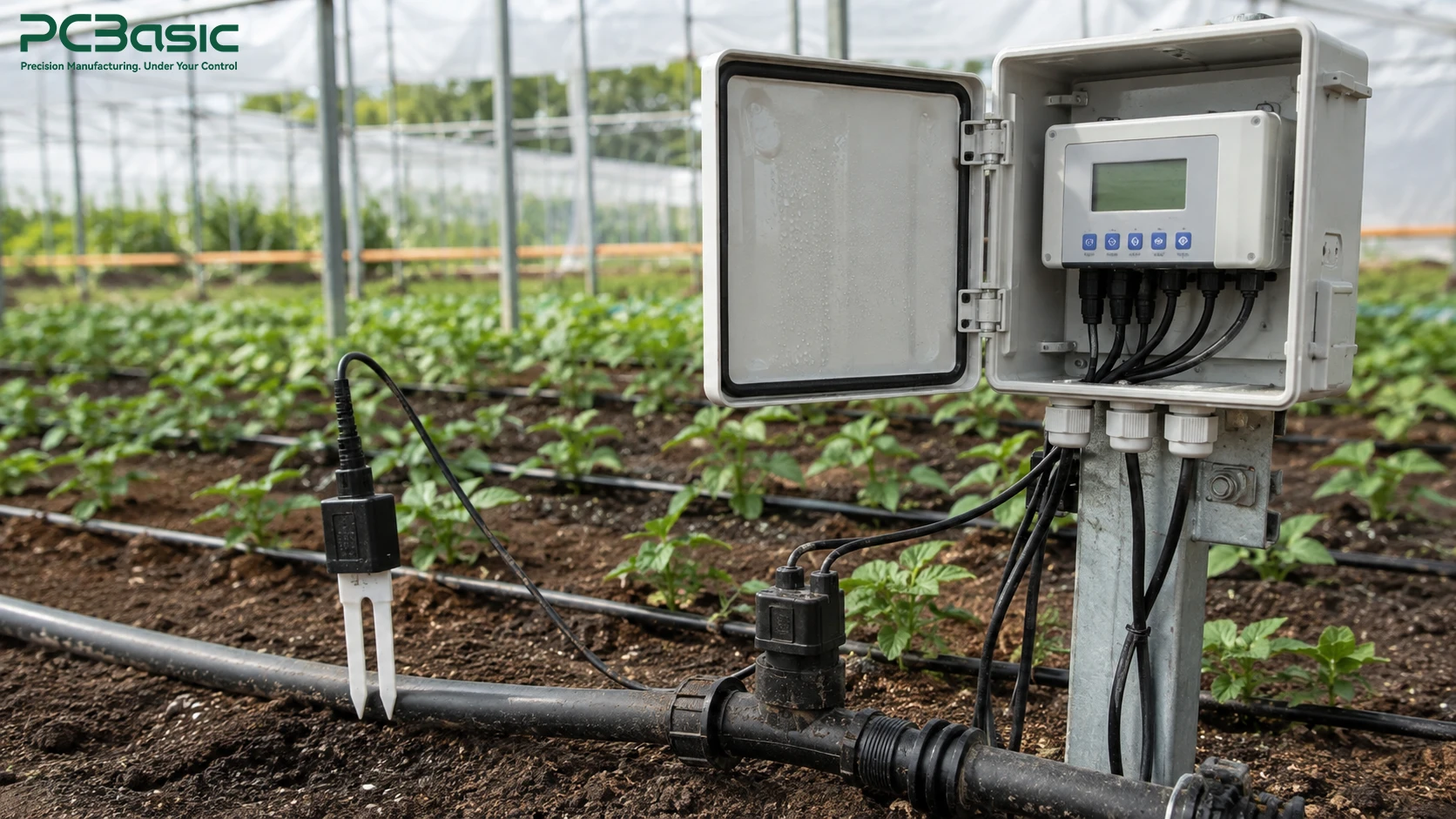
Even the best design of a schematic only goes
halfway. The manufacturing process decides whether this design turns out to be
a reliable smart farming PCB assembly or an array of failures.
DFM and BOM Review Before Production
Design
for Manufacturing (DFM) review detects footprint mismatches, close
tolerance between components, and parts nearing the end of their life cycle
prior to becoming costly issues. Bill of Materials (BOM) review highlights
single sourced components which could halt manufacturing for months if the
supplier runs out.
SMT, Through-Hole and Mixed Assembly
Many agriculture PCB assemblies combine
surface-mount components with through-hole parts such as connectors, terminals,
relays, or mechanically loaded components. Each assembly process requires
suitable soldering parameters, tooling, handling, and inspection to achieve
consistent results.
Cleaning
and Conformal Coating
Certain flux residues or ionic contamination can
contribute to corrosion, leakage current, or reliability problems when moisture
is present. Where the application requires additional environmental protection,
appropriate cleaning followed by a compatible conformal coating, such as
acrylic, silicone, or polyurethane, can help protect the assembly from
condensation and chemical contamination.
Manufacturing Traceability and Change Control
The farm equipment lasts for up to ten years,
meaning that the manufacturer should be able to trace every board used to the
lot of components and the assembly date. The traceability comes in handy if a
component manufacturer later issues a recall or quality notice affecting a
specific production lot three years after a controller has been shipped to the
customer’s farm.
Change control is just as important. If an
end-of-life component is to be replaced with another one, then the new
component should be evaluated and approved against the relevant electrical,
mechanical, assembly, and reliability requirements as the old component that is
being replaced. A smart farming PCB assembly manufacturer should document these
changes to support consistency across repeat production batches.
How to Validate a Smart Agriculture PCBA Before
Field Deployment
Testing is where a smart agriculture PCBA either
earns its reliability claims or reveals a weakness before a customer does.
Process Inspection Finds Assembly Defects
Automated optical inspection (AOI) can detect
visible placement and soldering defects, while X-ray inspection is used when
solder joints are hidden beneath components such as BGAs or bottom-terminated
packages. These inspections are typically performed before functional power-on
testing.
Functional Testing Should Follow the Signal-to-Action Path
Testing cannot be limited to whether the board
powers up. PCBA
functional testing should follow the relevant signal-to-action path, for
example from simulated sensor input through processing and communication to
actuator output, according to the functions of the agricultural PCB assembly.
Environmental Validation Should Match the Deployment
The testing needs to simulate the real usage
conditions as well as any applicable industrial or product-specific standard
environment. For example, an agricultural electronics board assembly used in
desert irrigation pivots will be subjected to a very different kind of stress
than one used in a humid greenhouse.
What to Confirm with a PCBA Manufacturer Before Production
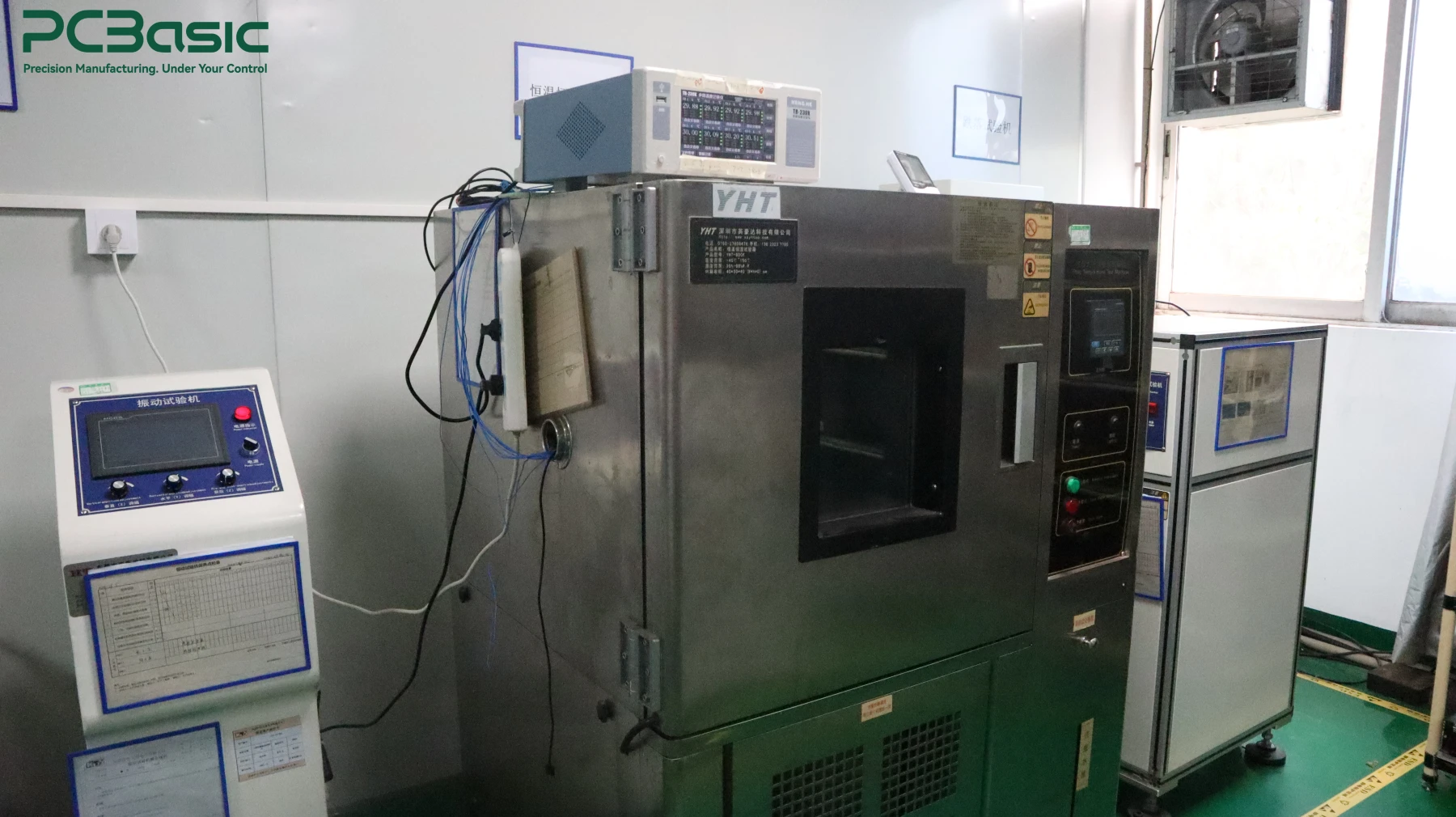
This could be done by checking on the
manufacturer’s ability to coat, environmental test chamber availability,
traceability data, and piloting a small production run prior to mass
production, so that PCBA reliability is in the very first queries and not something
thought about later on. This can all be accomplished via preliminary
discussions.
PCBasic uses this checklist on smart agriculture PCBA project before
any boards are built, checking the coating against the environment the board
will be used in, gathering environmental data rather than providing promises
later, and making a pilot batch so that customers can test the board’s
performance before entering full-scale production. This is how the process
takes the design review to the final board.
Conclusion
The agricultural equipment required needs to be robust enough to
survive the conditions starting from its very inception; adding environmental
protection late in development may not address all underlying design risks.
Engineering of a smart agricultural PCBA involves taking into consideration
temperature variations, noise, wireless performance, and mechanical stress
right from the first design review.
As precision agriculture becomes more dependent on connected
electronics, manufacturers need to understand the environment in which each
PCBA will operate. PCBasic does that in
all the projects we analyze in DFM and BOM reviews to detect potential flaws
before manufacturing, SMT and mixed assembly of sensor boards and connector
boards, conformal coating tailored to the application type (desert pivot,
greenhouse, or livestock tag), and environmental testing done based on the real
operating environment, rather than an industrial general standard. If you need
a sensor node, irrigation controller, or drone board development for the next
season, let us discuss the project requirements prior to finalizing the design
– it is way more cost-efficient than a field recall.
FAQs
Q1: What is a smart agriculture PCBA?
A1: It is a printed circuit board assembly that
has been designed specifically for agriculture electronics like sensors,
irrigation systems, drones, and IoT gateways and has been engineered to
withstand the harsh conditions outdoors.
Q2: Why does conformal coating matter
for agricultural PCB assembly?
A2: Conformal coating keeps moisture, dust, and chemicals common in
fields and greenhouses from damaging the boards thus extending the lifespan of
electronic circuits.
Q3: How is agricultural electronics testing
different from standard PCB testing?
A3: PCB environmental testing for the assembly
in agricultural equipment must take into account the actual conditions that
include temperature cycling, humidity, and vibration profiles of that specific
environment rather than those of an industrial environment.
Q4: Can one PCBA manufacturer handle
both sensors and drone controllers?
A4: While many manufacturers take care of both,
it might be worthwhile to check on their expertise with RF layout in wireless
communication, since sensor nodes and drones have different requirements for
the antennas they use.